
Helping clients with immigration forms is a deeply rewarding way to serve your community, but it all starts with one core principle: you are a skilled and ethical facilitator, not a legal advisor. Your role is to accurately transfer the information your client gives you onto the specific forms they have selected. The Latin American Immigration Association (LAIA) is dedicated to training professionals like you to navigate this process with confidence and integrity.
Defining Your Role as an Immigration Document Preparer

Starting a career as an immigration document preparer means taking on a role of immense responsibility. For many families, you are the crucial bridge helping them navigate a mountain of complex paperwork. To do this job right, you must work within very clear professional boundaries.
Your main function is to provide non-legal, administrative help. LAIA provides non-legal training in immigration document preparation, focusing on these key tasks:
- Transcribing Information: You will type the client’s answers directly into the fields on the USCIS form they have given you. Accuracy is everything.
- Translating Documents: If you are bilingual, you can offer certified translations for documents that are not in English, like birth certificates or marriage licenses.
- Assembling Packages: A large part of the job is organizing the completed forms, all the required evidence, and the correct filing fees into a neat, complete package ready for submission.
- Submitting the Application: You may also be responsible for mailing the final package to the correct USCIS lockbox.
Throughout every step, you must avoid the “unauthorized practice of law.” This means you cannot advise a client on which form to file, suggest what proof they should include, or guess at the legal outcomes of the information they provide. These services are limited to translating, typing, and submitting client-provided information.
The Clear Line: Document Preparer vs. Legal Advisor
It’s easy to get confused about what’s allowed and what isn’t. Having a clear understanding of the two roles—document preparer and licensed attorney—helps keep the boundaries front and center.
Here’s a simple breakdown to guide you:
Document Preparer vs. Legal Advisor Roles
| Task | Permitted for Document Preparer (Your Role) | Requires a Licensed Attorney |
|---|---|---|
| Typing Answers | ✅ Yes, you can type the client’s exact answers onto a form. | ❌ No, this is an administrative task. |
| Choosing a Form | ❌ No, you cannot advise which form is best for their situation. | ✅ Yes, this is considered legal advice. |
| Explaining Legal Options | ❌ No, you cannot interpret immigration law or outcomes. | ✅ Yes, this is the core function of an attorney. |
| Translating Documents | ✅ Yes, you can provide certified translations of documents like birth certificates. | ❌ No, this is a non-legal service. |
| Assembling a Package | ✅ Yes, you can organize the forms and evidence the client provides. | ❌ No, this is an administrative task. |
| Recommending Evidence | ❌ No, you cannot suggest which specific documents to include as proof. | ✅ Yes, this requires legal strategy. |
| Representing a Client | ❌ No, you cannot speak for a client to USCIS or in court. | ✅ Yes, legal representation is exclusive to attorneys. |
This table is a great tool for explaining your role to clients. Being upfront about these limitations from the very first conversation builds trust and protects everyone involved.
Establishing Trust and Compliance From Day One
Your first meeting with a client lays the foundation for your entire professional relationship. It’s your chance to show them you’re trustworthy by being completely transparent about what you can and cannot do.
Imagine this common scenario: A new client asks, “My brother is a U.S. citizen. Which form do I need so he can petition for me?” This question is a test of your professional boundaries.
A compliant, professional response would be: “That’s a great question, but helping you choose the right form is considered legal advice, which I’m not authorized to provide. My role is to help you accurately fill out the specific form you decide to use. I recommend you consult with a qualified immigration attorney to determine the best path for your situation.
This answer protects you and the client. It shows your commitment to ethical practice and points them toward the expert help they need. You can dive deeper into these responsibilities in our detailed guide on becoming an immigration forms specialist.
The Demand for Ethical Document Assistance
The need for your services is greater than ever. The U.S. immigration system faces a massive number of applications, creating significant backlogs and making the process incredibly complicated for applicants.
According to USCIS data from 2023, over 800,000 family-based petitions were filed. The strain on the system is clear, with millions of cases pending across various categories. This highlights how valuable skilled preparers are. You help clients submit applications that are complete and accurate, reducing simple mistakes that cause even more delays.
By operating with integrity, you empower people in your community to face this challenging process with more clarity and confidence.
Accurately Completing and Translating USCIS Forms
Once your client has chosen the correct immigration form, your most critical job begins: ensuring every piece of information is entered with 100% accuracy. This isn’t just data entry; it’s a careful process where your precision can prevent long delays and stress for your client.
This is especially vital for forms that determine a person’s ability to live and work here, like Form I-765, Application for Employment Authorization. A simple mistake—a mistyped date of birth or a misspelled name—can get the application denied, forcing the client to start over. Your attention to detail is an act of empowerment.
Best Practices for Transcribing Client Information
The golden rule is simple: transfer information exactly as the client provides it. Your job is not to guess, interpret, or fill in blanks with your own assumptions. If a client’s birth certificate lists their middle name as “Javier,” you must write “Javier.”
Here are some real-world tips for maintaining accuracy:
- Double-Check Everything: After filling out a section, read it back and compare it directly against the client’s source documents.
- Know Your “N/A” and “None”: Never leave a field blank unless the form instructions explicitly tell you to. Most USCIS forms require you to write “N/A” (for “not applicable”) or “None” if a question doesn’t apply.
- The Final Client Review: Before considering it done, sit with your client and go through the entire form together, line by line. This is the last and best chance to catch any mix-ups.
A Quick Word on Integrity: Your professional responsibility is to make the form a perfect mirror of your client’s information. You should never alter answers or suggest they provide different information to get a specific outcome. That is a serious ethical line that constitutes the unauthorized practice of law.
The Critical Skill of Certified Translation
Many of your clients, especially those from Latin American communities, will provide essential documents in Spanish. USCIS requires a complete and certified English translation for any foreign language document you submit.
A certified translation needs more than just translated words; it requires a signed statement from the translator confirming its accuracy. If you want to dig deeper into the specifics of different forms, our guide on understanding USCIS immigration forms is a great resource. This certification must state that the translator is fluent in both languages and that the translation is complete and correct.
What a Proper Translation Certification Looks Like
Good news: the certification doesn’t have to be notarized, just signed and dated. It should be typed on its own sheet of paper and attached to both the original foreign language document and the English translation.
Here is a simple template you can adapt:
Certification by Translator
I, [Full Name of Translator], certify that I am fluent in the English and Spanish languages, and that the above/attached document is an accurate translation of the document attached titled [Name of Original Document].
Signature: ___________________________
Date: ________________
Printed Name: _________________________
Address: ____________________________
Mastering these foundational skills—pinpoint accuracy and certified translation—is what separates the pros from the amateurs. It builds trust with your clients and gives you the confidence to handle their needs effectively.
Finalizing and Assembling the Application Package
You’ve meticulously transcribed the information, double-checked the translations, and now you’re at the final stage: assembling the submission package.
This is where your attention to detail truly shines. A clean, perfectly organized package makes the USCIS adjudicator’s job easier, which can only help your client. A messy or incomplete one is a recipe for rejections or frustrating delays.
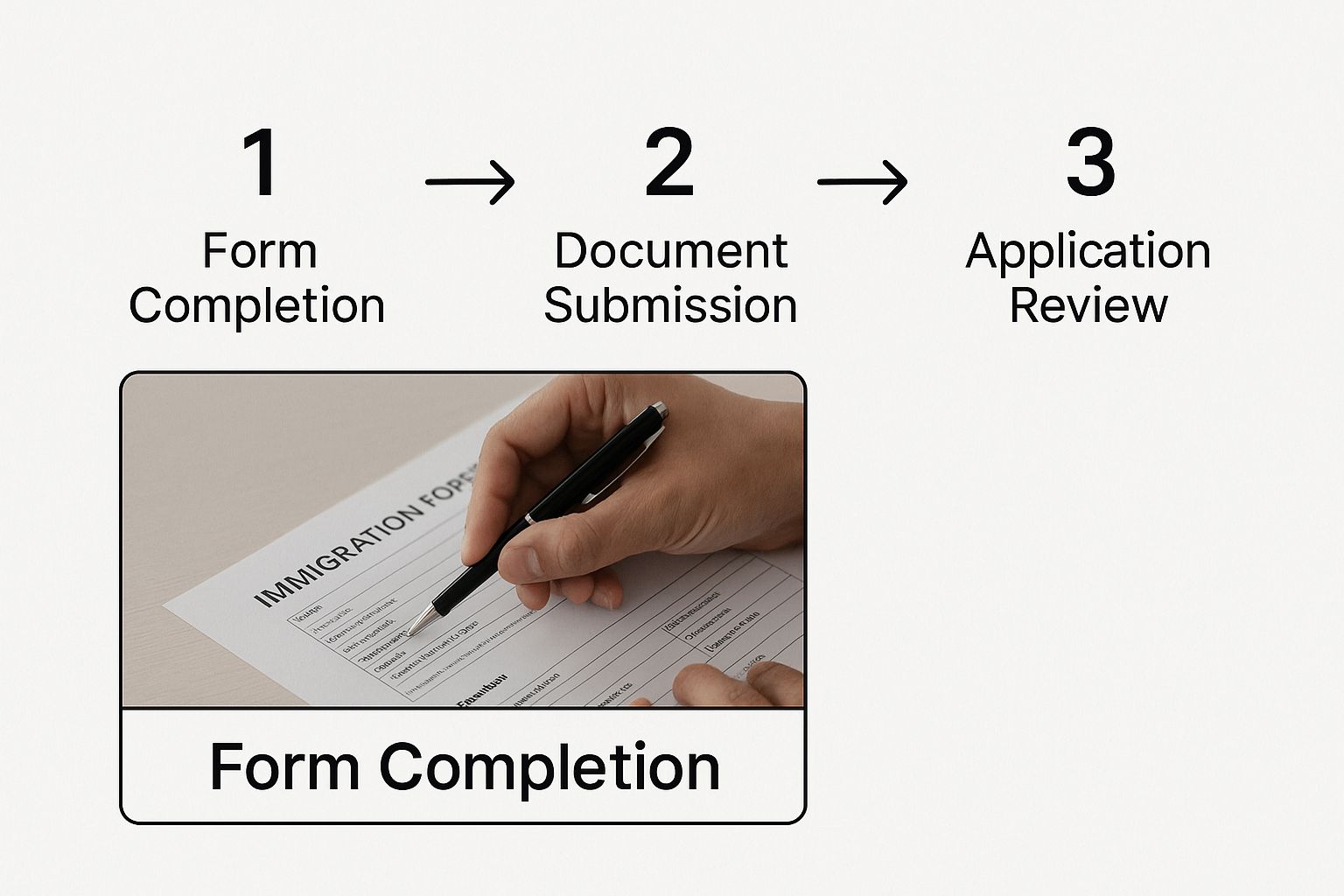
The hands-on work of putting everything together is a vital part of providing compliant, effective non-legal immigration services.
The Final Review Checklist
Before stacking a single page, a thorough final review is non-negotiable. This is your quality control checkpoint. Aim for perfection, catching any tiny error that could become a major problem.
Use this checklist to comb through every page:
- All Questions Answered: Are there any empty fields? Unless instructed otherwise, every question needs an answer. Use “N/A” or “None” as appropriate.
- Signatures and Dates: Check every signature line. Did the client sign? Did you sign as the preparer? Are the dates correct? A missing signature is a common reason for rejection.
- Correct Form Version: Look at the edition date at the bottom of the form. USCIS updates its forms constantly. Submitting an old version is an automatic rejection.
- Information Consistency: Do all names, birth dates, and addresses match perfectly across every document? Even a small typo can cause delays.
A Critical Reminder on Your Role: Remember, your review is for completeness and accuracy based on the client’s information. It is not for legal sufficiency. You’re ensuring the package is put together correctly, not advising on whether the evidence is strong enough. That’s a job for an attorney.
Stacking the Submission Package Correctly
Believe it or not, the order of the documents matters. A logically stacked package helps the USCIS officer process the case efficiently. While you should always check the specific form’s instructions, here is the generally accepted best practice for stacking:
- Filing Fee: The check, money order, or Form G-1450 (Authorization for Credit Card Transactions) goes right on top.
- Cover Letter (Optional but Recommended): A simple letter listing the package’s contents is very helpful.
- The Primary USCIS Form: Next comes the main petition or application, like a Form I-130 or I-485.
- Supporting Forms: Any other forms, such as an I-864 or I-765, follow the primary one.
- Supporting Evidence: Finally, place all required evidence—birth certificates, marriage licenses, passport photos, and their certified translations.
This creates a smooth, logical flow for the person reviewing the file.
The Importance of Making Copies
Once the package is assembled, signed, and ready for mailing, there’s one last crucial step: make a complete copy of the entire package.
Do not skip this. This copy is an essential record for both you and your client.
- For Your Records: The copy is your proof of the work you did and your protection, showing exactly what was submitted.
- For the Client’s Records: Giving your client a full copy empowers them. They have a complete record for their own files.
This final step is a mark of professionalism. It demonstrates your commitment to providing a thorough, compliant service and reinforces the trust your client has placed in you.
Managing the Submission and Post-Filing Process
Getting the completed package in the mail is a huge relief for your client, but your job isn’t finished. Your professional assistance is still needed during the submission and post-filing phases. This part of the journey requires the same attention to detail and ethical care.
Your role now shifts from form preparer to informational guide. You’ll help with mailing logistics, explain what to expect from U.S. Citizenship and Immigration Services (USCIS), and clearly define your boundaries if new requests arise.
Finding the Correct USCIS Mailing Address
One of the most common points of confusion is figuring out where to mail the package. USCIS has multiple facilities, and the right address depends on the form and the client’s state.
Sending a package to the wrong place can cause an immediate rejection and heartbreaking delays. To find the right mailing address, always go straight to the source: the USCIS website.
- Go to the “Forms” section and find the page for the specific form.
- Look for a section called “Where to File.”
- Read the directions very carefully, as they can change.
Never rely on old instructions or memory. Taking a minute to verify the address is a quick but critical step.
Mailing the Package With Confidence
Once you’ve triple-checked the address, discuss how to send the package. Standard mail is not recommended for something this important. You and your client need proof of delivery.
The two best options are:
- USPS Certified Mail with Return Receipt: This gives you a tracking number and a physical green card mailed back as proof of delivery.
- Courier Service (FedEx, UPS, DHL): These services provide detailed, real-time tracking and a guaranteed delivery date.
Professional Tip: Always choose a mailing method that includes a tracking number. This is non-negotiable. It’s your concrete proof of when and where the package was delivered.
Preparing Your Client for What Happens Next
After the package is sent, the waiting begins. Your job here is to set clear, realistic expectations about the post-filing timeline.
The complexity of immigration forms and shifting government policies require that you stay informed about application statuses. You can find a wealth of official immigration and citizenship data from USCIS to better understand current trends.
Typically, here’s what your client can expect to receive in the mail:
- Form I-797C, Notice of Action (Receipt Notice): Usually arrives 2-4 weeks after filing. It confirms the case was accepted and provides a unique receipt number for tracking.
- Biometrics Appointment Notice: For many applications, the client will get a notice for an appointment to have their fingerprints, photo, and signature taken.
- Potential Request for Evidence (RFE): If an officer needs more information, they’ll send an RFE. You can explain its general purpose, but you cannot advise them on how to respond. That crosses into legal advice, and you must refer the client to an attorney.
Helping clients manage these next steps and understand the possibility of immigration forms processing delays is a key part of providing excellent, compliant service.
Common Mistakes Immigration Document Preparers Must Avoid

Serving your community as an immigration document preparer is a role built on trust. While learning the right way to fill out forms is crucial, knowing what not to do is just as important. The smallest slip-up can create massive problems for your client and put your business at risk.
This goes beyond the obvious rule of never giving legal advice. Many well-meaning preparers make subtle mistakes that can be seen as the unauthorized practice of law (UPL). To protect your clients and your reputation, you must master these critical boundaries.
Giving Subtle or Unintentional Legal Advice
The most dangerous mistakes often come from a genuine desire to be helpful. A client asks a seemingly innocent question, and your answer accidentally crosses the line from clerical assistance to legal guidance.
Consider these common but risky scenarios:
- A client asks, “Which visa is faster, the one for a spouse or the one for a fiancé?” If you tell them one is “usually quicker,” you’ve just given legal advice.
- Another client shows you a pile of documents, asking, “Is this enough proof of our marriage?” Reassuring them that it “looks good” is also legal advice.
In both situations, you’re interpreting legal requirements—a task reserved for licensed attorneys.
The Compliant Response: You need a prepared script for these moments. A safe and ethical reply is, “That’s an excellent question that gets into legal strategy. My role is to accurately fill out the forms with the information you give me, but I can’t advise on which path to take or what evidence to include. I strongly recommend you discuss that with a qualified immigration attorney.”
Using Vague or Misleading Language
How you describe your services matters. Using unclear terms can create false expectations and attract legal trouble. Precision in your language is a cornerstone of compliance.
You must avoid advertising your business with terms like:
- “Immigration Consulting”
- “Immigration Help” or “Assistance”
- “Immigration Services” (without clarification)
These phrases imply you offer guidance or counsel. Instead, use specific terms like “Immigration Form Preparation,” “Document Completion Service,” or “Non-Legal Form Filing Assistance.” Every contract, business card, and website page must clearly state you are not an attorney and do not provide legal advice.
Mishandling Common USCIS Form Errors
Beyond major legal boundaries, simple clerical errors can cause serious delays. As a preparer, you are the first line of defense against these preventable mistakes. In fact, many of the top 10 USCIS form preparation mistakes are things a careful preparer can easily catch.
A high-quality review process means checking for these common pitfalls:
- Leaving fields blank: Every question requires an answer. Use “N/A” or “None.”
- Using an outdated form: Submitting an old version is an automatic rejection.
- Incorrect filing fees: Always double-check the current fee on the official USCIS website.
A Practical Guide to Compliant Alternatives
Understanding what to avoid is the first step. The next is knowing what to do instead. Here’s a quick-glance table to help you stay on the right side of the line.
Common Preparer Mistakes and Compliant Alternatives
| Common Mistake (What to Avoid) | Compliant Alternative (The Right Way) | Why It Matters |
|---|---|---|
| Suggesting which form to file. | Explain your role is limited to filling out the form the client has already chosen. Refer them to an attorney if they are unsure. | Choosing a form is a foundational legal decision. The wrong one can derail a person’s entire immigration future. |
| Advising on evidence. | Instruct the client to provide all documents listed in the official USCIS form instructions. Period. | Deciding if evidence is “strong” or “sufficient” requires a legal analysis of their specific case facts. |
| Interpreting a form question. | Read the question verbatim to the client and ask them how they would like to answer. | Explaining what a question means is legal interpretation and falls completely outside a preparer’s role. |
| Promising specific outcomes. | State that you will ensure the form is completed accurately based on their information, but all decisions are made by USCIS. | You cannot guarantee approval or processing times. Doing so is misleading, unethical, and a huge red flag. |
By committing to these ethical standards, you build a sustainable business that genuinely empowers your community. You provide a desperately needed service, helping families navigate complex paperwork with confidence—all while operating safely within your professional, non-legal role.
Frequently Asked Questions About Form Preparation
Here are answers to some of the most common questions we receive at LAIA, designed to help you confidently navigate your role as an immigration document preparer.
Q: Can I help my client choose the right immigration form?
A: No. LAIA and its affiliates do not provide legal advice or legal representation. Choosing which form to file is a legal decision. Your role begins after the client has already determined which form they need, often with the help of a qualified immigration attorney. If a client asks for your opinion, your compliant response should be to refer them to a legal professional.
Q: What is the difference between translating and interpreting?
A: These terms have very different meanings. Translation is the direct, word-for-word conversion of a written document from one language to another (e.g., a birth certificate). This is a service you can provide. Interpretation is explaining the meaning of a question or concept, which you are not allowed to do for USCIS forms as it constitutes legal advice.
Q: How should I advertise my non-legal immigration services?
A: The language you use in your marketing must be crystal clear to avoid misleading clients. Stick to specific, accurate phrases like “Immigration Form Preparation,” “Document Completion Assistance,” or “Non-Legal Form Filing Services.” You must avoid vague terms like “immigration consulting” or “immigration solutions.” Every ad and contract must include a clear disclaimer that you are not an attorney and do not provide legal advice. Our guide on how to assist clients with immigration forms dives deeper into ethical marketing.
Q: What do I do if my client gets a Request for Evidence (RFE)?
A: When a client receives an RFE, you can explain what it is—a request from USCIS for more information. However, your role ends there. You cannot advise the client on how to respond or what evidence to gather. Analyzing and responding to an RFE is a legal task, and you must strongly urge the client to seek a qualified immigration lawyer immediately.
Q: Are LAIA’s services considered legal advice?
A: No. LAIA provides non-legal training in immigration document preparation. Our services are limited to educating individuals on how to perform administrative tasks like translating, typing, and submitting client-provided information. LAIA and its affiliates do not provide legal advice or legal representation.
Ready to empower your community by providing ethical, high-quality document preparation services? The Latin American Immigration Association offers the premier training you need to launch or grow your business with confidence and full compliance.