
If you’re looking to become an immigration consultant in California, you’ve likely heard about a “surety bond.” Understanding this key requirement is one of the first steps toward launching a compliant and trustworthy business. At the Latin American Immigration Association (LAIA), we believe that knowledge is power, and we’re here to clarify what this bond means for you.
Answering the question, “what is the surety bond for an immigration consultant in California?” is straightforward: it’s a mandatory $100,000 financial guarantee required by the state. Think of it not as your own insurance policy, but as a security deposit that guarantees your professional integrity. Its purpose is to protect your clients from financial harm if you make a serious error or engage in fraud.
What Exactly Is a California Immigration Consultant Bond?

At its heart, the California Immigration Consultant Bond is a three-party contract. This agreement is designed to build public trust and ensure you are held accountable for your work. It creates a solid legal promise between you, the State of California, and a surety company.
Understanding the roles in this agreement is crucial for becoming a compliant and respected consultant. It forms the foundation of ethical service in the immigration field.
The Key Players in the Bond Agreement
Every surety bond agreement involves three parties, each with a specific job:
- The Principal: This is you, the immigration consultant. By obtaining the bond, you promise to follow all state laws and conduct your business ethically.
- The Obligee: This is the California Secretary of State, representing the public. The obligee requires the bond to protect consumers from potential misconduct.
- The Surety: This is the insurance or surety company that issues your bond. The surety financially guarantees your promise to the state.
Here’s how it works: if a consultant fails to meet their legal duties and a client loses money, that client can file a claim against the bond. The surety company would then compensate the client, and the consultant is legally required to repay the surety company.
This legal framework is the cornerstone of consumer protection in the immigration assistance field. It ensures professionals are held to a high standard and that clients have a path to financial recovery if things go wrong.
A Mandatory Requirement to Operate
Let’s be clear: in California, you cannot legally operate as an immigration consultant without this bond. It is non-negotiable.
Since July 1, 2014, the state has mandated a $100,000 bond under Business and Professions Code Section 22443.1. This isn’t a one-time task; the bond must be filed with the Secretary of State and renewed continuously to maintain your registration.
Here are the essential details at a glance:
California Immigration Consultant Bond at a Glance
| Requirement | Details |
|---|---|
| Bond Amount | $100,000 |
| Required By | California Secretary of State |
| Who Needs It? | All registered immigration consultants in California. |
| Purpose | To protect clients from financial loss due to consultant fraud or error. |
| Term | Two years, must be renewed to maintain your registration. |
This requirement, combined with a mandatory background check, helps ensure that only qualified and accountable individuals can offer these vital services. For a deeper dive, see our guide on California surety bonds for immigration consultants.
Why Is the Bond Requirement $100,000?

It’s natural to wonder why the $100,000 bond requirement is so high. The answer is simple and powerful: consumer protection. This isn’t an arbitrary figure; it’s a safeguard California put in place to protect vulnerable immigrant communities from unethical practices and financial harm.
The bond serves two critical functions. First, it acts as a financial screening tool, helping to ensure that only serious and committed professionals enter the field. Second, it provides a crucial safety net for your clients.
A History of Protecting Consumers
The move to a $100,000 bond was a direct response to a real problem. Previously, the required bond amount was much lower, which lawmakers found was often not enough to cover the damages in serious cases of fraud or negligence. In 2013, the state passed Assembly Bill 1159, raising the requirement to its current level.
This change reflects a deep commitment to shielding immigrant families from exploitation. The Secretary of State’s office actively oversees compliance, which includes the bond, background checks, and other important disclosures.
A Badge of Honor for Ethical Professionals
At LAIA, we encourage aspiring professionals to view this requirement not as a hurdle, but as a badge of honor. It shows you are invested in building a business based on trust and integrity.
Obtaining this bond signals to the community that you are a serious, ethical, and professional service provider.
Meeting this standard immediately sets you apart as a professional who is committed to operating lawfully. It’s a key part of building a reputable business that truly serves the community. To learn more about how the bond fits into your practice, read our detailed guide on surety bonds for immigration consultants.
How Much Will You Actually Pay for the Bond?

The $100,000 requirement can feel intimidating, but here’s the good news: you don’t actually pay that full amount. Instead, you pay a much smaller fee to a surety company called a premium. This is your real, out-of-pocket cost to get bonded.
Think of it like an insurance policy where you pay a small premium for a large amount of coverage. This system makes the $100,000 bond accessible for serious professionals looking to start their business.
Factors That Influence Your Premium Cost
What determines your final price? The single biggest factor is your personal credit score. Surety companies review your credit history to gauge the level of risk they are taking by backing your professional promise.
A strong credit history demonstrates financial responsibility and directly translates to a lower premium. For applicants with good credit, the premium is often quite affordable—just another manageable business expense.
Key Insight: Your personal financial health is directly tied to the startup costs of your immigration consulting business. Maintaining good credit can save you hundreds or even thousands of dollars on your bond premium.
The cost of the $100,000 surety bond for an immigration consultant in California truly comes down to your creditworthiness. For applicants with solid credit, the premium usually falls between 1.7% and 2% of the total bond amount. This means a $100,000 bond might cost around $1,700 for a two-year term, making it a predictable expense. You can learn more by visiting surety agencies that specialize in these products.
Options for Less-Than-Perfect Credit
If your credit isn’t perfect, don’t worry—you still have options. While a lower credit score often leads to a higher premium, many surety companies specialize in providing bonds for people in various financial situations. The premium might be higher, but securing the bond is still very achievable and won’t stop you from pursuing your business goals.
Your Step-by-Step Guide to Getting Bonded
Ready to get started? Securing your $100,000 bond can feel like a big step, but the process is straightforward when you know what to expect. Think of it as a manageable checklist for getting your business up and running.
1. Find a Licensed Surety Provider
First, you’ll need to find a surety company licensed to do business in California. It’s important to know that not all insurance companies offer surety bonds, so you will be looking for specialized providers. Research and compare quotes from a few different companies to find the best rate.
2. Complete the Application
Once you select a provider, you will fill out their bond application. This form is standard and will ask for basic business information and some personal details. Having a personal financial statement ready will make the process much smoother.
3. Undergo the Underwriting Review
Next is the underwriting review. The surety company will take a closer look at your application and run a credit check. Your personal credit score is the most significant factor in determining your premium, as the surety is assessing the risk involved in guaranteeing your professional conduct.
The infographic below shows a typical timeline for getting bonded.
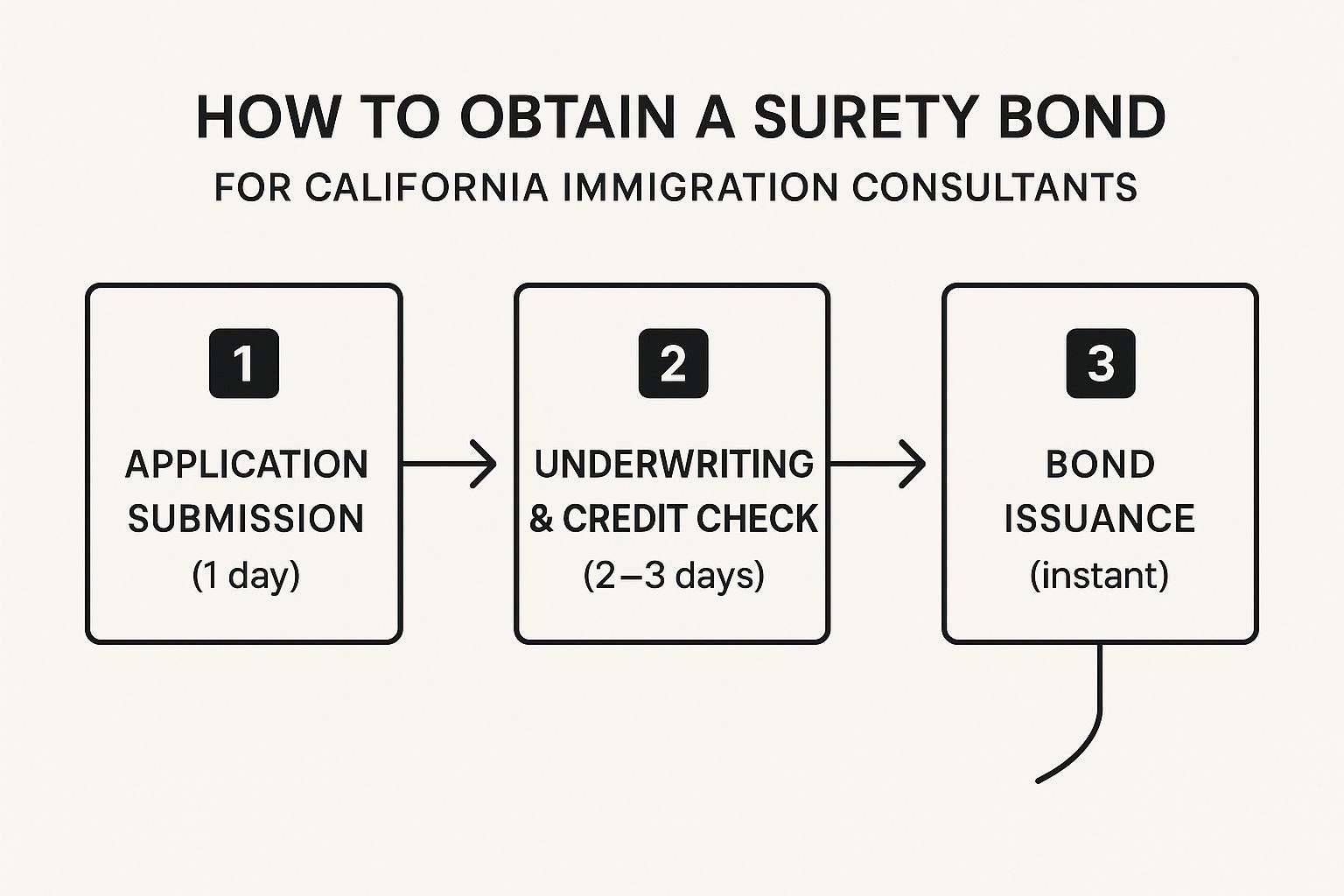
As you can see, the entire process—from application to issuance—can often be completed in just a few business days.
4. File Your Bond with the Secretary of State
After you pay the premium, the surety will issue the official bond document. The final, critical step is to file this document with the California Secretary of State as part of your consultant registration. Remember, while LAIA provides training on compliance, we do not provide legal advice or endorse specific bond providers.
For a complete look at the entire registration journey, explore our guide on how to become a bonded immigration consultant.
Maintaining Your Bond and Staying Compliant
Getting your surety bond is a huge achievement, but it’s the starting line, not the finish. Staying compliant every day is what builds a trustworthy, long-term business. Your bond isn’t just a paper you buy once; it’s an active credential that proves your commitment to your clients.
In California, your bond has a two-year term. You must renew it on time, before it expires, to keep your legal authority to operate. If it lapses, the Secretary of State can suspend your registration immediately, bringing your business to a halt.
More Than Just the Bond
While the bond is foundational, it’s just one part of your professional duties. Operating ethically means following all state rules designed to protect the people you serve. These are not optional suggestions—they are legal requirements.
Beyond renewing your bond, your key duties include:
- Using Compliant Contracts: Every client agreement must be in writing and include specific disclaimers and information required by state law.
- Keeping Meticulous Records: You must maintain detailed files for every client, including contracts, copies of documents you prepared, and a clear record of all payments.
- Following Service Limitations: You must be clear about the non-legal services you can provide. Stepping into anything that resembles the unauthorized practice of law can lead to serious legal trouble.
Remember, answering “what is the surety bond for an immigration consultant in California?” is about demonstrating your commitment to consumer protection. Each of these ongoing duties reinforces that commitment.
Following these rules isn’t just about avoiding fines; it’s about protecting your profession’s integrity. For a full breakdown, review our guide on California immigration consultant registration and surety bond compliance.
Frequently Asked Questions About the Surety Bond
Getting into the details of becoming an immigration consultant can bring up many questions. Let’s answer some of the most common ones about the California surety bond so you can move forward with confidence.
Q: Do I really pay $100,000 to get the bond?
A: No, this is the biggest misconception. You do not pay the full $100,000 bond amount. Instead, you pay a much smaller fee, known as a premium, to a surety company. This premium is typically between 1% and 3% of the bond amount, meaning your actual out-of-pocket cost is usually between $1,000 and $3,000 for the bond’s two-year term, depending on your credit.
Q: What happens if someone makes a claim against my bond?
A: If a client files a valid claim showing they lost money due to your professional misconduct or a serious error, the surety company will pay the client for those damages. However, you are then legally required to repay the surety company for every dollar they paid out, plus any legal fees. The bond protects your clients, it is not an insurance policy for you.
Q: Can LAIA help me find a company to get a surety bond?
A: No. LAIA’s mission is to provide you with high-quality training in non-legal immigration document preparation. While our training covers the bond requirement, we are an educational organization and do not offer financial services or recommend specific surety providers. You will need to research and connect directly with a licensed surety company.
Q: Is the surety bond the only requirement to become a consultant?
A: The surety bond is a critical piece, but it’s not the only one. To become a registered immigration consultant in California, you must also:
- File a disclosure form with the Secretary of State.
- Pass a full background check.
- Submit a copy of your photo ID and a recent passport-style photo.
- Commit to working strictly within the legal boundaries set for non-attorneys.
Understanding these boundaries is fundamental. For a full rundown, see our guide on how to become an immigration consultant in California.
Q: What kind of services can a bonded immigration consultant provide?
A: A bonded immigration consultant in California provides non-legal services. This is strictly limited to tasks like translating answers to English on a form, typing information onto a form that the client has provided, and helping a client gather required documents. Consultants cannot provide legal advice, choose forms for a client, or represent clients before USCIS.
Ready to build a career serving your community with integrity and professionalism? The Latin American Immigration Association provides the essential, non-legal training you need to prepare immigration documents ethically and effectively. Learn more about our courses and start your journey today. Visit us at https://latinimmigration.org.