

Could Immigration Document Preparation Be Your Next Career Move?
Could Immigration Document Preparation Be Your Next Career Move?
Maybe you enjoy helping people work through complicated paperwork. Perhaps you already serve your community through tax preparation, translation, or administrative services. Or you’re simply looking for work that feels more meaningful.
If you’ve considered immigration document preparation but aren’t sure where to begin, start with this question:
Is this a field I would enjoy learning—and doing well?
You don’t need to have an entire business plan ready to explore the answer. Understanding the work is a useful first step.
You May Already Have Skills Worth Building On
Think about the responsibilities you handle today. Do you organize information, notice small details, communicate in more than one language, or help people follow instructions?
Those skills can provide a foundation for learning document preparation.
Being bilingual, for example, may help you communicate with people who feel more comfortable discussing paperwork in their preferred language. Administrative experience may help you manage records and follow a consistent process.
These strengths do not replace training or any applicable requirements. But they can give you a starting point.
Explore Work That Connects With Your Community
For many people, the appeal of this field goes beyond paperwork.
It is the opportunity to interact with families, use their language skills, and provide organized, attentive service. If you enjoy patient, detail-oriented work, immigration document preparation may be worth exploring.
It also requires an honest look at your interests. Are you comfortable checking information carefully? Can you follow procedures without rushing? Are you willing to keep learning and recognize the limits of your role?
Understanding those expectations can help you decide whether the field fits your goals.
Get Familiar With the Work Before Planning a Business
It is easy to jump ahead to business names, websites, and finding clients. But first, it helps to understand what the day-to-day work involves.
Before making bigger decisions, explore questions such as:
- What does immigration document preparation involve?
- Which skills would I need to develop?
- What responsibilities and professional boundaries should I understand?
- What requirements apply where I plan to work?
- Would I enjoy the careful, structured nature of the work?
Learning about the field can help you make a more informed decision about your next step.
Give Yourself a Structured Place to Begin
Searching online can introduce you to the field, but it can also leave you with scattered information and unanswered questions.
A structured training program gives you a dedicated opportunity to study, ask questions, and become more familiar with the subject.
Instead of feeling that you must figure everything out before starting, you can approach training as part of your exploration: a way to understand the work and assess how it fits your future.
Take the Next Step With LAIA
Latin American Immigration Association’s live immigration training offers an opportunity to begin learning in a structured setting.
If this field has been on your mind, take a closer look at the curriculum. Consider what you want to learn, bring your questions, and give yourself an opportunity to explore the possibilities.
Your first step doesn’t have to be opening a business. It can be understanding the work.
Explore Our Live Immigration Training

Application Spotlight: Form I-130, Petition for Alien Relative
Family-based immigration is one of the most common areas in which immigration document preparers assist their communities. At the center of many family-based cases is Form I-130, Petition for Alien Relative.
Because this application often begins a family member’s immigration journey, it is especially important that the form and supporting documents are prepared carefully and accurately.
What Is Form I-130?
Form I-130 is filed by an eligible U.S. citizen or lawful permanent resident who wants to establish a qualifying family relationship with a relative seeking to immigrate to the United States.
Depending on the petitioner’s immigration status and the relationship involved, the application may be used for a:
- Spouse
- Parent
- Child
- Son or daughter
- Brother or sister
The person filing the petition is called the petitioner, while the relative for whom the petition is filed is called the beneficiary.
Approval of Form I-130 does not automatically provide the beneficiary with a Green Card or legal immigration status. Its primary purpose is to establish that a qualifying family relationship exists. After approval, additional steps are generally required before the relative can become a lawful permanent resident.
Why Is It Important to Get Form I-130 Right?
Although Form I-130 may appear straightforward, it requires detailed information about both the petitioner and beneficiary. The filing must also be supported by documents establishing the petitioner’s status and the claimed family relationship.
Depending on the case, supporting evidence may include birth certificates, marriage certificates, divorce records, photographs, proof of U.S. citizenship or permanent residence, and evidence showing that a marriage is genuine.
Mistakes can create serious administrative problems. Missing answers, inconsistent dates, incomplete documentation, an outdated edition of the form, or an incorrect filing fee could result in rejection, requests for additional evidence, or delays.
USCIS specifically advises applicants to complete every required section and submit the appropriate supporting evidence. Before preparing a package, consultants should always review the current form, instructions, filing fee, and filing location on the official USCIS Form I-130 page.
The Immigration Consultant’s Role
Where permitted by applicable state law, a trained immigration consultant may provide nonlegal assistance with an I-130 package by:
- Entering information provided by the client
- Organizing supporting documents
- Checking the package for unanswered questions
- Preparing copies and translations
- Assembling documents in an orderly manner
- Helping the client follow published USCIS instructions
However, immigration consultants are not attorneys. They cannot determine whether someone is legally eligible, select an immigration strategy, interpret immigration law, or advise a client about the consequences of filing. Questions requiring legal judgment must be referred to a qualified immigration attorney or authorized legal representative.
A Foundational Application for Consultants
Form I-130 is an important application for immigration consultants to understand because family petitions are among the most common immigration needs within local communities.
Learning the form means understanding more than where information belongs. Consultants must learn how to collect client information consistently, organize relationship evidence, identify missing documents, recognize warning signs, and know when a case requires an attorney.
When handled responsibly, careful document preparation can help families begin the immigration process with a complete, professional, and properly organized application package.
Interested in learning how to prepare Form I-130 and other commonly used family-based immigration applications?
Learn More About LAIA’s Comprehensive Immigration Training
This article is intended for general educational purposes and is not legal advice. Immigration consultants must comply with all applicable federal, state, and local requirements.
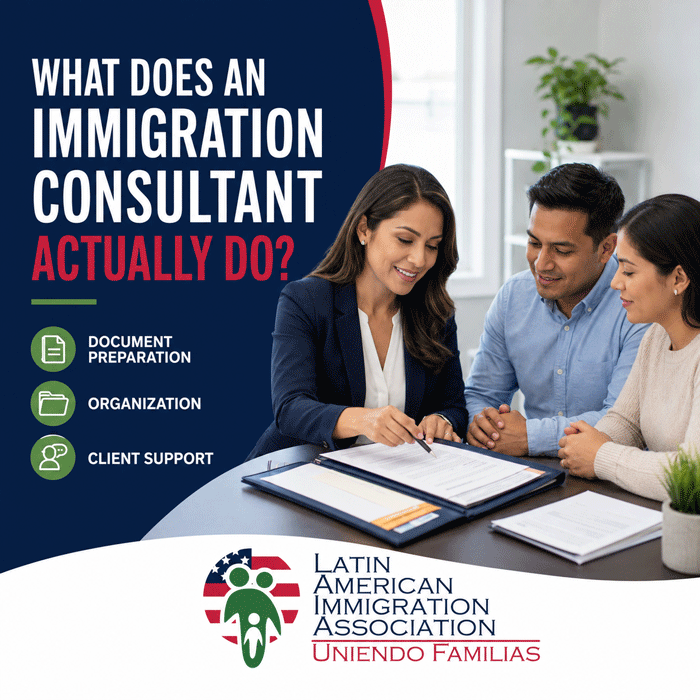
What Does an Immigration Consultant Do?
What Does an Immigration Consultant Actually Do?
The immigration process often involves lengthy forms, detailed instructions, supporting evidence, filing fees, deadlines, and strict document-assembly requirements. For someone unfamiliar with the process, or someone who is not confident reading or completing complicated paperwork, it can quickly become overwhelming.
That is where a properly trained immigration consultant can provide valuable support.
An immigration consultant is not an attorney and does not practice immigration law. Instead, the consultant helps clients with the confusing nonlegal document-preparation side of common immigration processes.
Simply put, immigration consultants are trusted professionals who help community members prepare, organize, and submit the documents needed for many common immigration processes.
Helping Clients Manage Complicated Paperwork
Many immigration applications require more than completing a single form. Applicants may need to collect identity documents, financial records, photographs, certificates, translations, relationship evidence, and other supporting materials.
Even when someone knows which immigration benefit they are seeking, understanding how to organize everything can be challenging. Missing information, inconsistent answers, incomplete documents, or improperly assembled materials may create confusion and potentially lead to delays.
Where permitted by applicable law, an immigration consultant may provide administrative assistance such as:
- Entering client-provided information onto immigration forms
- Typing, formatting, copying, and organizing documents
- Helping clients follow official form instructions and document checklists
- Organizing supporting materials provided by the client
- Assembling documents into a clearly ordered submission package
- Providing translation or interpretation services when qualified to do so
- Making copies and maintaining organized client files
- Assisting with routine administrative correspondence
- Helping clients keep track of paperwork and important dates
- Referring clients to an immigration attorney when legal advice is needed
A consultant’s role is not to make legal decisions for the client. The consultant’s value comes from being organized, accurate, professional, and familiar with the administrative requirements involved in preparing immigration documents.
Immigration Consultants Are Not Immigration Attorneys
One of the most important things to understand is the difference between immigration document preparation and legal representation.
Immigration consultants are not authorized to practice law unless they are also licensed attorneys or otherwise separately authorized. They cannot tell a client which immigration benefit to pursue, determine whether someone qualifies for a particular status, recommend a legal strategy, interpret immigration law, or represent a client in immigration court.
Current guidance from the U.S. Department of Justice explains that immigration consultants, document preparers, visa consultants, and notarios cannot provide legal advice or represent individuals in immigration court.
Only qualified attorneys and certain Department of Justice-accredited representatives are authorized to provide immigration legal services within the scope of their authority. Accredited representatives must work or volunteer through a DOJ-recognized nonprofit organization; accreditation is not the same as operating independently as an immigration consultant.
A responsible immigration consultant understands these boundaries and recognizes when a client’s situation requires an attorney. Knowing when to stop providing administrative assistance and make a referral is an essential professional skill.
The Importance of Accuracy and Organization
Immigration document preparation requires more than basic data entry. Consultants frequently work with sensitive personal information, important records, and documents that may affect a family’s future.
Successful consultants must be patient, detail-oriented, and consistent. They should carefully review documents for completeness, confirm that information has been entered as provided by the client, follow official instructions, maintain secure records, and use clear processes for every client.
A dependable consultant should also communicate clearly about:
- What administrative services are being provided
- What the consultant is not authorized to do
- The fees associated with the service
- Which documents the client must provide
- Which decisions remain the client’s responsibility
- When an attorney referral is necessary
The goal is not to promise a result. No consultant can guarantee that USCIS or another government agency will approve an application. The goal is to provide accurate, organized, ethical document-preparation assistance within the limits of the law.
Requirements Vary by State
The rules governing immigration consultants are not identical throughout the United States. Some states impose registration, bonding, disclosure, contract, advertising, background-check, or recordkeeping requirements. Other states may restrict the services consultants can provide or the titles they can use.
For example, the California Secretary of State states that a person must meet specific requirements before acting as an immigration consultant in California, including filing a $100,000 surety bond and passing a background check.
Completing a training course does not, by itself, satisfy every legal requirement in every state. Anyone planning to offer immigration document-preparation services must research and follow the current federal, state, and local rules that apply to their business.
Who May Be Well Suited for This Work?
Immigration document preparation may appeal to people who enjoy helping others and working with detailed information.
Strong candidates may already have experience in:
- Administrative support
- Customer service
- Tax preparation
- Translation or interpretation
- Notary services
- Insurance or financial services
- Community outreach
- Document management
- Small-business ownership
Being bilingual can be a valuable advantage, but language ability alone is not enough. Consultants also need proper training, attention to detail, professional ethics, strong organizational systems, and a clear understanding of the unauthorized practice of law.
Why This Service Matters to Local Communities
Many people feel intimidated by government forms and administrative procedures. They may struggle with language barriers, technology, document organization, or uncertainty about how to follow published instructions.
A well-trained immigration consultant can make the administrative process feel more manageable. By helping clients organize their paperwork, maintain accurate records, and understand the next administrative step, consultants can provide a meaningful service to families in their communities.
The consultant does not replace an attorney. Instead, the consultant fills a different role: providing nonlegal document-preparation and organizational support when that assistance is permitted by law.
Could Immigration Document Preparation Be Right for You?
If you are organized, detail-oriented, comfortable working with people, and interested in providing an important community service, immigration document preparation may be worth exploring.
However, good intentions are not enough. Before serving clients, you need practical training, professional procedures, an understanding of document requirements, and a firm grasp of what immigration consultants can and cannot do.
The Latin American Immigration Association provides comprehensive training designed to help participants learn the administrative side of family-based immigration document preparation. The training also emphasizes professional boundaries, proper package assembly, common warning signs, and avoiding the unauthorized practice of law.
Simply put, immigration consultants help community members navigate the paperwork associated with common immigration needs—while knowing when a situation must be handled by a qualified attorney.
Interested in learning more about becoming an immigration consultant?
Explore LAIA’s immigration training programs and take the next step toward developing a valuable professional skill.
LEARN MORE ABOUT IMMIGRATION CONSULTANT TRAINING
This article is for general informational purposes and is not legal advice. Immigration-consultant laws and requirements vary by jurisdiction and may change. Prospective consultants should review current requirements in every location where they intend to provide services.
5 Reasons To Become An Immigration Consultant NOW!
Greg McKewen
Listen to This Article
1. The Demand is HIGH
The need and demand for knowledgeable and trusted immigration professionals has never been higher in recent times.
Consider this; We have a new Presidential Administration enacting major changes to our immigration policies. This disruption is the cause of major concern and even fear in immigrant communities across the nation. Why not stand become part of the major movement in the increase of non-attorney immigration service providers and begin providing help and unity to your clients or community members.
2. It’s about “People Helping People”
Imagine helping good people with a variety of different services. From helping them with what may be one of their biggest dreams of becoming a United States citizen, to helping reunite families, to assisting our young “Dreamers” with their DACA status so that they may continue living and experiencing the American dream.
3. It’s Rewarding
So imagine that first client that you help transition from “Legal Permanent Resident Status” to “American Citizenship”!!! What would that “feel” like for you?
If the answer is “it would feel pretty damn good”, then immigration consulting may just be the field for you.
- Download our FREE 12 Step Guide to Starting Your Own Immigration Consulting Business here.
4. The Marketplace is Enormous
The marketplace for immigration services professionals is a multi-billion dollar industry. Did you know that just in the last three years, the submission of immigration applications has been surging?
Check out just one statistical fact on immigration applications: These stats come directly from www.uscis.gov
Immigration applications submitted to the USCIS within the last 3 years:
2015 – Over 7.2 million applications
2016 – Over 8 million applications
2017 – Over 8.5 million applications
2018 – Nearly 9 million applications
How would you like to get some of this market share by HELPING your clients and community members with valuable and needed “non-legal” immigration services?
5. The opportunity to stand up for something you believe in
Immigration consulting offers you the opportunity to do what is right for immigrants in your community and neighborhoods. We are, after all, a country of immigrants from all over the globe. One of the many things that makes America great is our long and rich history of immigration, immigration which has shaped the America that we all live in.